Managed Services Market: The Strategic IT Partner for Modern Business

An Overview of the Global Managed Services Market
In an increasingly complex and technology-dependent business world, many organizations are choosing to offload the burden of day-to-day IT management to expert third parties. This is the core of the managed services market, a massive and rapidly growing sector where businesses proactively outsource responsibility for maintaining and anticipating the needs of a range of IT processes and functions. A detailed analysis of the Managed Services Market showcases a model that shifts IT from a reactive, break-fix approach to a proactive, strategic partnership. Instead of calling for help when something breaks, a Managed Service Provider (MSP) continuously monitors, manages, and improves a client's IT infrastructure and systems for a flat monthly fee. This provides businesses with predictable IT costs, access to specialized expertise, enhanced security, and the freedom to focus on their core strategic goals rather than on IT firefighting.
Exploring the Key Drivers of Managed Services Adoption
The widespread adoption of the managed services model is driven by a confluence of pressing business and technology challenges. A primary driver is the increasing complexity of IT environments. The shift to cloud computing, the proliferation of mobile devices, and the constant threat of cybersecurity attacks have created a landscape that is difficult for in-house IT teams, especially in small and medium-sized businesses (SMBs), to manage effectively. The chronic shortage of skilled IT talent is another major factor. MSPs provide access to a deep bench of experts in areas like cybersecurity, cloud architecture, and network management, which would be prohibitively expensive for most companies to hire directly. The need for robust cybersecurity is also a huge driver, with many businesses turning to Managed Security Service Providers (MSSPs) to protect them from the ever-evolving threat landscape. Ultimately, the model allows businesses to convert unpredictable capital expenditures into predictable operational expenses.
Understanding Market Segmentation and Service Offerings
The managed services market is segmented by the type of service provided, the size of the client business, and the end-user industry. By service type, the market is incredibly diverse. Key offerings include: Managed IT Infrastructure (covering servers, networks, and data centers), Managed Security (firewall management, threat detection and response), Managed Cloud Services (managing infrastructure on AWS, Azure, etc.), Managed Communication and Collaboration (voice and video systems), and Managed Applications. By business size, MSPs serve everyone from small businesses, which may outsource their entire IT function, to large enterprises, which may outsource specific, specialized functions. The market serves all industries, with high adoption in sectors like healthcare, finance, and retail, which have significant compliance and security requirements. The competitive landscape ranges from thousands of small, local MSPs to large, global IT service providers.
Navigating Challenges and Identifying Opportunities in the MSP Space
The managed services market, while growing, is not without its challenges. For MSPs, competition is fierce, which can put pressure on pricing and profit margins. The need to constantly invest in new technologies and train staff to keep up with the rapid pace of change is a significant and ongoing expense. Ensuring the security of their own systems is paramount, as a compromised MSP could lead to breaches across all of their clients. For clients, a key challenge can be a perceived loss of control over their IT environment. However, the opportunities are vast. Specialization is a key to success, with many MSPs finding success by focusing on a specific industry vertical (like legal or dental practices) or a specific technology (like cloud security). The shift to the cloud continues to create massive opportunities for MSPs to guide their clients through migration and then manage their cloud environments. Offering strategic C-level advice (virtual CIO services) is another way MSPs are moving up the value chain.
Global Trends and the Future of Outsourced IT
The managed services market is a global phenomenon, with strong growth in all regions as businesses of all sizes embrace digital transformation. The future of the market will be defined by automation, AI, and a deeper focus on business outcomes. MSPs will increasingly use AI and automation tools to proactively identify and resolve IT issues before they impact the client. The service offering will continue to evolve from managing technology to helping clients achieve specific business goals, such as improving productivity or entering new markets. The line between MSP and business consultant will continue to blur. As technology becomes even more integral to business success, the role of the MSP as a trusted, strategic partner will only become more critical.
Categories
Read More
Recovering from surgery requires a thoughtful and well-structured approach to ensure safety, comfort, and effective healing. Many patients today prefer Post-surgical Care at Home in Dubai because it allows them to recover in a familiar environment while receiving personalized attention. With the support of Doctor at Home services, individuals can access professional medical care without the...

The Online Digital Artwork Market research report has been crafted with the most advanced and best tools to collect, record, estimate, and analyze market data. The report also sheds light on the market overview in its entirety touching diverse aspects like product definition, prevailing vendor landscape, and market segmentation. Through the comprehensive and systematic market research study,...

The latest business intelligence report released by Polaris Market Research on Contract Cleaning Services Market Share, Size, Trends, Industry Analysis Report, By Type (Window Cleaning, Floor & Carpet Cleaning, Upholstery Cleaning, Construction Cleaning, Others); By End-use; By Region; Segment Forecast, 2023-2032. It covers the in-depth knowledge of the Contract Cleaning Services Market...

The latest business intelligence report released by Polaris Market Research on Reading Glasses Market Share, Size, Trends, Industry Analysis Report, By Type (Prescription Reading Glasses and OTC Reading Glasses); By Age Group; By Distribution Channel; By Region; Segment Forecast, 2024 - 2032. It covers the in-depth knowledge of the Reading Glasses Market Share that includes opportunities,...

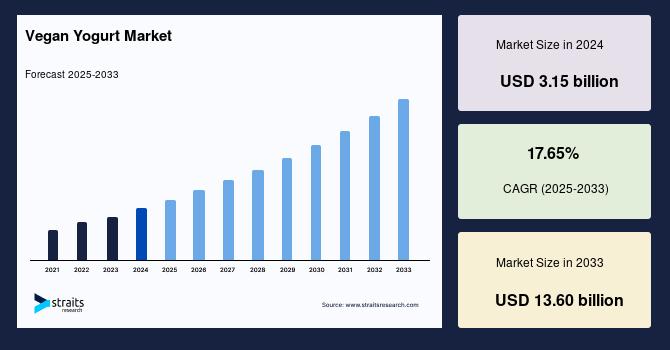
The global vegan yogurt market is experiencing robust growth as consumers increasingly shift toward plant-based diets and dairy alternatives. Vegan yogurt, made from plant-based ingredients such as almond, soy, coconut, and oats, is gaining popularity due to its health benefits, lactose-free nature, and environmental sustainability. Market Overview The global vegan yogurt market was valued...